Go to the source code of this file.
Enumerations | |
| enum | IndexType { EVEN_X = 0, EVEN_Y = 1, EVEN_Z = 2, EVEN_T = 3 } |
Functions | |
| template<int nDim, QudaDWFPCType type, int dim, int nLayers, int face_num, typename Param > | |
| static __device__ int | indexFromFaceIndex (int face_idx, const Param ¶m) |
| Compute global checkerboard index from face index. The following indexing routines work for arbitrary (including odd) lattice dimensions. Specifically, we compute an index into the local volume from an index into the face. This is used by the Wilson-like face packing routines. This routine can handle 4-d or 5-d fields, and well as 4-d or 5-d preconditioning. More... | |
| template<int dim, int nLayers, int face_num, typename Param > | |
| static __device__ int | indexFromFaceIndexExtended (int face_idx, const Param ¶m) |
| Compute global extended checkerboard index from face index. The following indexing routines work for arbitrary (including odd) lattice dimensions. Specifically, we compute an index into the local volume from an index into the face. This is used by the Wilson-like face packing routines. More... | |
| template<int dim, int nLayers, int face_num, typename Param > | |
| static __device__ int | indexFromFaceIndexStaggered (int face_idx_in, const Param ¶m) |
| Compute global checkerboard index from face index. The following indexing routines work for arbitrary lattice dimensions (though perhaps not odd like thw Wilson variant?) Specifically, we compute an index into the local volume from an index into the face. This is used by the staggered-like face packing routines, and is different from the Wilson variant since here the halo depth is tranversed in a different order - here the halo depth is the faster running dimension. More... | |
| template<int dim, int nLayers, int face_num, typename Param > | |
| static __device__ int | indexFromFaceIndexExtendedStaggered (int face_idx, const Param ¶m) |
| Compute global extended checkerboard index from face index. The following indexing routines work for arbitrary lattice dimensions (though perhaps not odd like thw Wilson variant?) Specifically, we compute an index into the local volume from an index into the face. This is used by the staggered-like face packing routines, and is different from the Wilson variant since here the halo depth is tranversed in a different order - here the halo depth is the faster running dimension. More... | |
| template<KernelType dim, int nLayers, int Dir, typename Param > | |
| static __device__ void | coordsFromFaceIndexStaggered (int x[], int idx, const Param ¶m) |
| Compute the full-lattice coordinates from the input face index. This is used by the staggered halo update kernels. More... | |
| template<int nDim, QudaDWFPCType type, int dim_, int nLayers, typename Int , typename Param > | |
| static __device__ void | coordsFromFaceIndex (int &idx, int &cb_idx, Int *const x, int face_idx, const int &face_num, const Param ¶m) |
| Compute the full-lattice coordinates from the input face index. This is used by the Wilson-like halo update kernels, and can deal with 4-d or 5-d field and 4-d or 5-d preconditioning. More... | |
| template<int nDim, QudaDWFPCType pc_type, IndexType idxType, typename T , typename Param > | |
| static __device__ __forceinline__ void | coordsFromIndex (int &idx, T *x, int &cb_idx, const Param ¶m) |
| Compute coordinates from index into the checkerboard (used by the interior Dslash kernels). This is used by the Wilson-like interior update kernels, and can deal with 4-d or 5-d field and 4-d or 5-d preconditioning. More... | |
| template<IndexType idxType, typename Int , typename Param > | |
| static __device__ __forceinline__ void | coordsFromIndex3D (int &idx, Int *const x, int &cb_idx, const Param ¶m) |
| Compute coordinates from index into the checkerboard (used by the interior Dslash kernels). This is the variant used by the shared memory wilson dslash. More... | |
| template<int dim, typename T > | |
| static __device__ bool | inBoundary (const int depth, const int coord[], const T X[]) |
| Compute whether the provided coordinate is within the halo region boundary of a given dimension. More... | |
| template<typename T > | |
| static __device__ bool | isActive (const int threadDim, int offsetDim, int offset, const int y[], const int partitioned[], const T X[]) |
| Compute whether this thread should be active for updating the a given offsetDim halo. This is used by the fused halo region update kernels: here every thread has a prescribed dimension it is tasked with updating, but for the edges and vertices, the thread responsible for the entire update is the "greatest" one. Hence some threads may be labelled as a given dimension, but they have to update other dimensions too. Conversely, a given thread may be labeled for a given dimension, but if that thread lies at en edge or vertex, and we have partitioned a higher dimension, then that thread will cede to the higher thread. More... | |
| template<int nDim = 4, typename Param > | |
| __device__ int | dimFromFaceIndex (int &face_idx, const int tid, const Param ¶m) |
| Determines which face a given thread is computing. Also rescale face_idx so that is relative to a given dimension. If 5-d variant if called, then it is assumed that param.threads contains only the 3-d surface of threads but face_idx is a 4-d index (surface * fifth dimension). At present multi-src staggered uses the 4-d variant since the face_idx that is passed in is the 3-d surface not the 4-d one. More... | |
| template<int nDim = 4, typename Param > | |
| __device__ int | dimFromFaceIndex (int &face_idx, const Param ¶m) |
| template<int nDim, int nLayers, typename I , typename Param > | |
| static __device__ void | faceIndexFromCoords (int &face_idx, I *const x, int face_dim, const Param ¶m) |
| Compute the face index from the lattice coordinates. More... | |
| template<typename T > | |
| __device__ int | block_idx (const T &swizzle) |
| Swizzler for reordering the (x) thread block indices - use on conjunction with swizzle-factor autotuning to find the optimum swizzle factor. Specfically, the thread block id is remapped by transposing its coordinates: if the original order can be parametrized by. More... | |
| __device__ float | __fast_pow (float a, int b) |
Enumeration Type Documentation
◆ IndexType
| enum IndexType |
| Enumerator | |
|---|---|
| EVEN_X | |
| EVEN_Y | |
| EVEN_Z | |
| EVEN_T | |
Definition at line 530 of file dslash_index.cuh.
Function Documentation
◆ __fast_pow()
Definition at line 911 of file dslash_index.cuh.
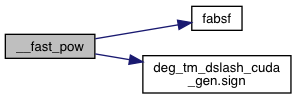
References a, b, fabsf(), and deg_tm_dslash_cuda_gen::sign().
◆ block_idx()
|
inline |
Swizzler for reordering the (x) thread block indices - use on conjunction with swizzle-factor autotuning to find the optimum swizzle factor. Specfically, the thread block id is remapped by transposing its coordinates: if the original order can be parametrized by.
blockIdx.x = j * swizzle + i,
then the new order is
block_idx = i * (gridDim.x / swizzle) + j
We need to factor out any remainder and leave this in original ordering.
- Parameters
-
[in] swizzle Swizzle factor to be applied
- Returns
- Swizzled block index
Definition at line 883 of file dslash_index.cuh.
References gridDim, and fused_exterior_ndeg_tm_dslash_cuda_gen::i.
◆ coordsFromFaceIndex()
|
inlinestatic |
Compute the full-lattice coordinates from the input face index. This is used by the Wilson-like halo update kernels, and can deal with 4-d or 5-d field and 4-d or 5-d preconditioning.
- Parameters
-
idx[out] The full lattice coordinate cb_idx[out] The checkboarded lattice coordinate x[out] Coordinates we are computing .dc.face_idx[in] Input checkerboarded face index [in] param Parameter struct with required meta data
Definition at line 442 of file dslash_index.cuh.
References dim, face_idx, face_num, idx, INTERIOR_KERNEL, param, QUDA_4D_PC, QUDA_5D_PC, QudaGaugeParam_s::X, X, and x.
◆ coordsFromFaceIndexStaggered()
|
inlinestatic |
Compute the full-lattice coordinates from the input face index. This is used by the staggered halo update kernels.
- Parameters
-
x[out] Coordinates we are computing idx[in] Input checkerboard face index [in] param Parameter struct with required meta data
Definition at line 362 of file dslash_index.cuh.
References dim, EXTERIOR_KERNEL_T, EXTERIOR_KERNEL_X, EXTERIOR_KERNEL_Y, EXTERIOR_KERNEL_Z, idx, param, QudaGaugeParam_s::X, X, x, x0h, Xh, za, and zb.
◆ coordsFromIndex()
|
static |
Compute coordinates from index into the checkerboard (used by the interior Dslash kernels). This is used by the Wilson-like interior update kernels, and can deal with 4-d or 5-d field and 4-d or 5-d preconditioning.
- Parameters
-
idx[out] The full lattice coordinate cb_idx[out] The checkboarded lattice coordinate x[out] Coordinates we are computing idx[in] Input checkerboarded face index [in] param Parameter struct with required meta data
(X[0] & 1)
(X[1] & 1)
(X[2] & 1)
Definition at line 550 of file dslash_index.cuh.
References deg_tm_dslash_cuda_gen::block(), EVEN_X, EVEN_Y, EVEN_Z, fused_exterior_ndeg_tm_dslash_cuda_gen::i, idx, param, QUDA_4D_PC, s, t, QudaGaugeParam_s::X, X, x, y, and z.
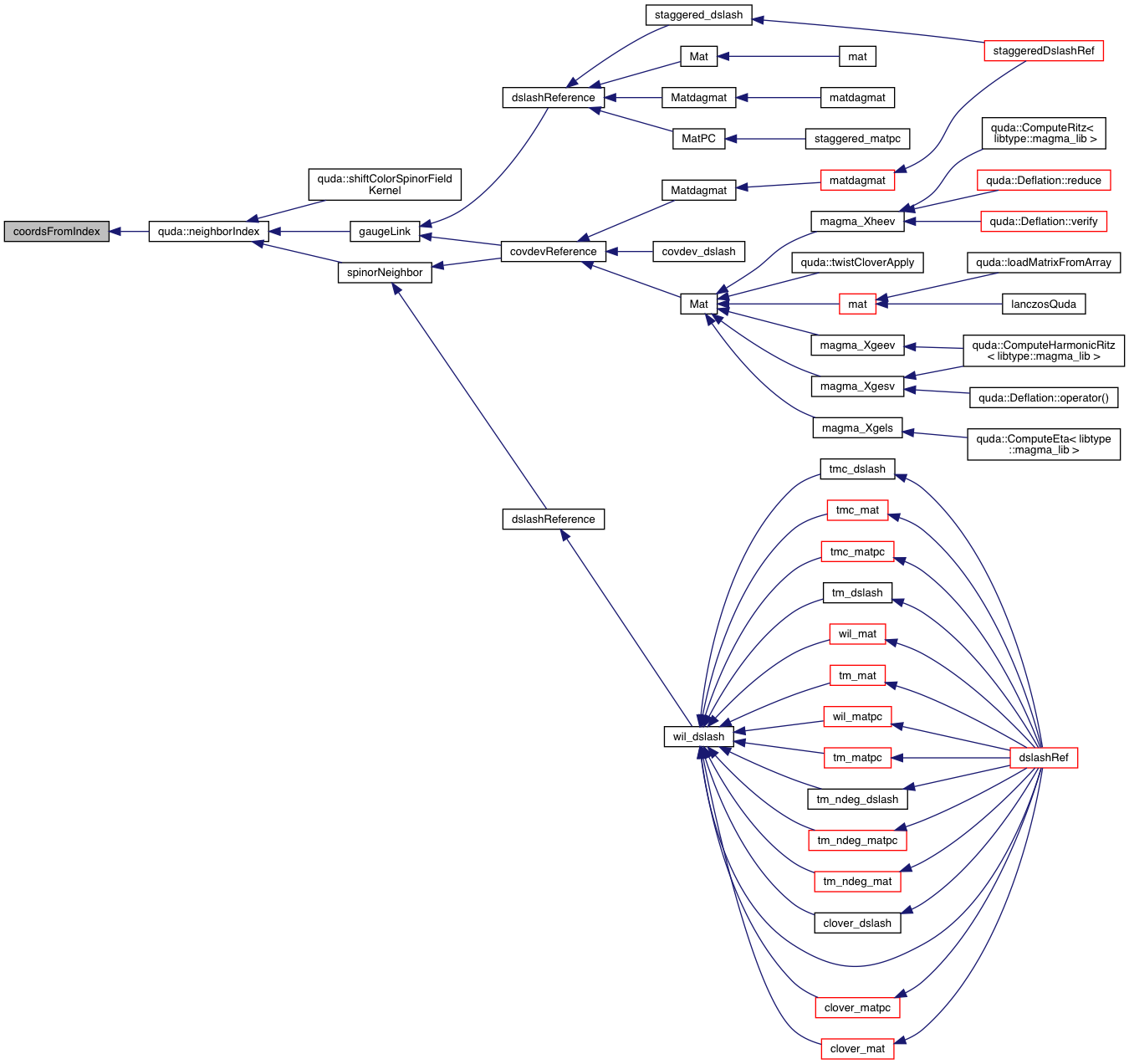
Referenced by quda::neighborIndex().

◆ coordsFromIndex3D()
|
static |
Compute coordinates from index into the checkerboard (used by the interior Dslash kernels). This is the variant used by the shared memory wilson dslash.
- Parameters
-
[out] idx Linear index [out] x Compute coordinates [out] ch_idx Linear checkboard index [in] param Parameter struct with required meta data
Definition at line 697 of file dslash_index.cuh.
◆ dimFromFaceIndex() [1/2]
|
inline |
Determines which face a given thread is computing. Also rescale face_idx so that is relative to a given dimension. If 5-d variant if called, then it is assumed that param.threads contains only the 3-d surface of threads but face_idx is a 4-d index (surface * fifth dimension). At present multi-src staggered uses the 4-d variant since the face_idx that is passed in is the 3-d surface not the 4-d one.
- Parameters
-
[in] face_idx Face index [in] param Input parameters
- Returns
- dimension this face_idx corresponds to
Definition at line 808 of file dslash_index.cuh.
◆ dimFromFaceIndex() [2/2]
|
inline |
Definition at line 834 of file dslash_index.cuh.
◆ faceIndexFromCoords()
|
inlinestatic |
Compute the face index from the lattice coordinates.
- Parameters
-
[in] face_idx Face index [in] x Lattice coordinates [in] face_dim Which dimension [in] param Input parameters
- Returns
- dimension this face_idx corresponds to
Definition at line 846 of file dslash_index.cuh.
References face_idx, param, QudaGaugeParam_s::X, x, and y.
◆ inBoundary()
|
inlinestatic |
Compute whether the provided coordinate is within the halo region boundary of a given dimension.
- Parameters
-
[in] depth Depth of halo [in] coord Coordinates [in] X Lattice dimensions
- Returns
- True if in boundary, else false
Definition at line 727 of file dslash_index.cuh.
◆ indexFromFaceIndex()
|
inlinestatic |
Compute global checkerboard index from face index. The following indexing routines work for arbitrary (including odd) lattice dimensions. Specifically, we compute an index into the local volume from an index into the face. This is used by the Wilson-like face packing routines. This routine can handle 4-d or 5-d fields, and well as 4-d or 5-d preconditioning.
- Parameters
-
[in] face_idx Checkerboarded face index [in] param Parameter struct with required meta data
- Returns
- Global checkerboard coordinate
Definition at line 14 of file dslash_index.cuh.
References dim, face_idx, face_num, idx, if(), param, QUDA_4D_PC, QUDA_5D_PC, s, t, QudaGaugeParam_s::X, y, and z.

◆ indexFromFaceIndexExtended()
|
inlinestatic |
Compute global extended checkerboard index from face index. The following indexing routines work for arbitrary (including odd) lattice dimensions. Specifically, we compute an index into the local volume from an index into the face. This is used by the Wilson-like face packing routines.
- Parameters
-
[in] face_idx Checkerboarded face index [in] param Parameter struct with required meta data
- Returns
- Global extended checkerboard coordinate
Definition at line 110 of file dslash_index.cuh.
References dim, face_idx, face_num, idx, param, R, t, QudaGaugeParam_s::X, X, y, and z.
◆ indexFromFaceIndexExtendedStaggered()
|
inlinestatic |
Compute global extended checkerboard index from face index. The following indexing routines work for arbitrary lattice dimensions (though perhaps not odd like thw Wilson variant?) Specifically, we compute an index into the local volume from an index into the face. This is used by the staggered-like face packing routines, and is different from the Wilson variant since here the halo depth is tranversed in a different order - here the halo depth is the faster running dimension.
- Parameters
-
[in] face_idx_in Checkerboarded face index [in] param Parameter struct with required meta data
- Returns
- Global extended checkerboard coordinate
Definition at line 276 of file dslash_index.cuh.
References dim, face_idx, face_num, idx, param, R, t, V, QudaGaugeParam_s::X, X, y, and z.
◆ indexFromFaceIndexStaggered()
|
inlinestatic |
Compute global checkerboard index from face index. The following indexing routines work for arbitrary lattice dimensions (though perhaps not odd like thw Wilson variant?) Specifically, we compute an index into the local volume from an index into the face. This is used by the staggered-like face packing routines, and is different from the Wilson variant since here the halo depth is tranversed in a different order - here the halo depth is the faster running dimension.
- Parameters
-
[in] face_idx_in Checkerboarded face index [in] param Parameter struct with required meta data
- Returns
- Global checkerboard coordinate
Definition at line 207 of file dslash_index.cuh.
References dim, face_idx, face_num, idx, param, s, t, QudaGaugeParam_s::X, X, y, and z.
◆ isActive()
|
inlinestatic |
Compute whether this thread should be active for updating the a given offsetDim halo. This is used by the fused halo region update kernels: here every thread has a prescribed dimension it is tasked with updating, but for the edges and vertices, the thread responsible for the entire update is the "greatest" one. Hence some threads may be labelled as a given dimension, but they have to update other dimensions too. Conversely, a given thread may be labeled for a given dimension, but if that thread lies at en edge or vertex, and we have partitioned a higher dimension, then that thread will cede to the higher thread.
- Parameters
-
[in] threadDim Prescribed dimension of this thread [in] offsetDim The dimension we are querying whether this thread should be responsible [in] offset The size of the hop [in] y Site coordinate [in] partitioned Array of which dimensions have been partitioned [in] X Lattice dimensions
- Returns
- True if this thread is active
Definition at line 753 of file dslash_index.cuh.
References offset, width, X, and y.
Referenced by for().